Gas Installation
Gas installation that is tested, readable and compliant
Every gas appliance in a commercial kitchen is only as safe as the line feeding it. We supply and install the LPG pipework components that make a kitchen gas system verifiable — pressure gauges, isolation valves, brass fittings and test points — and commission the installation with a pressure test alongside a licensed gas engineer. Unlike the fabricated equipment in the rest of this catalogue, these are proprietary instruments we specify and fit rather than manufacture.
1
Product
Categories
Buying Guide
Gas Installation Equipment in Kenya — What to Know
What this line covers
Gas installation covers the components that carry and control LPG between the cylinder bank or bulk tank and each appliance: pressure gauges, isolation and appliance valves, brass tees and unions, and the test points used to prove the line holds pressure.
Why it matters in Kenya
Most Kenyan commercial kitchens run on LPG because it is cheaper per kW than grid electricity and unaffected by outages. That makes the gas line the single most safety-critical service in the room, and county fire and health inspections check that it is properly valved, tested and documented.
Best for
Any commercial kitchen with gas appliances — restaurants, hotels, schools, hospitals and institutional canteens — whether it is a new fit-out, an appliance addition, or an existing line that has never had a way to read its own pressure.
Also searched as LPG installation, gas pipework, gas fitting, gas line installation, commercial gas connection and kitchen gas piping.
Why a Gas Line Needs a Pressure Gauge
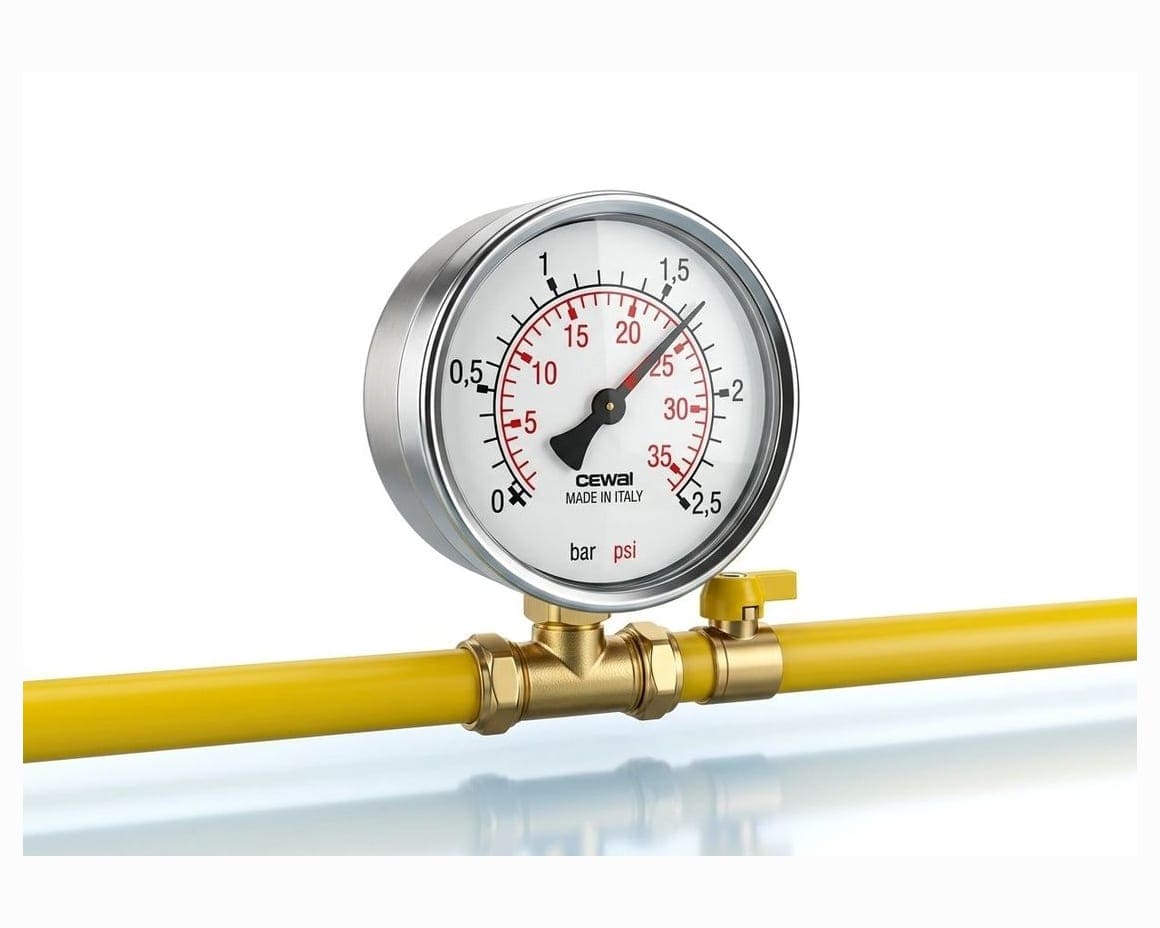
Without a gauge, low gas pressure is diagnosed by guesswork — usually by watching a burner underperform. A gauge turns that into a reading, which separates the three faults that look identical at the appliance.
- An empty or near-empty cylinder shows falling pressure
- A failed regulator shows wrong pressure even with gas available
- A blocked or undersized line shows pressure that drops when appliances fire together
- Fitting the gauge with an isolation valve lets it be replaced without draining the line
Sizing and Siting
Specify the gauge range to the working pressure of the line, not the cylinder pressure — an over-ranged dial puts your normal reading in the bottom tenth of the scale where nobody can read it. Then site it where a chef will actually look at it, which usually means at the manifold rather than behind an appliance.
Testing and Compliance
A commercial gas installation should be pressure-tested at commissioning and re-tested at service intervals, with the result recorded. We carry out gas connection and commissioning as part of installation work, and coordinate certification with a licensed gas engineer where the installation requires it — that documentation is what county inspectors and insurers ask for.
Gas Installation Price Guide — Indicative KES Ranges
Ranges reflect fabricated Grade 201 | 304 stainless steel at typical commercial specification. Final quotes depend on size, gauge, grade and site conditions.
| Item | Indicative range | What moves the price |
|---|---|---|
| Gas pressure gauge | KES 3,500 – 12,000 | Dial diameter and pressure range |
| Isolation valve with brass tee | KES 2,500 – 8,000 | Line size and valve type |
| Gauge and valve assembly, fitted | KES 8,000 – 22,000 | Components plus labour on an existing line |
| Pressure test and commissioning | KES 12,000 – 35,000 | Line length, appliance count, certification |
Gas Installation — Frequently Asked Questions
Why does a commercial kitchen need a gas pressure gauge?
So supply pressure can be read rather than guessed. Low pressure at the burner can mean an empty cylinder, a failed regulator, or a restricted line, and those three faults look identical at the appliance. A gauge tells you which one you have before you start replacing parts.
What pressure should a commercial LPG kitchen line run at?
It depends on the appliances, so the gauge range is specified to the designed working pressure of your installation rather than to a standard figure. What matters is that the normal reading sits in the middle of the dial, where a drift is obvious at a glance.
Do you install the gas line as well as supply the components?
Yes. Gas connection and commissioning are part of our installation scope, including a pressure test at handover. Where the installation requires certification we coordinate that with a licensed gas engineer, and the test record is issued with the handover documentation.
Do you manufacture these gas components?
No. Unlike the stainless steel equipment we fabricate in our own Nairobi workshop, gas gauges, valves and fittings are proprietary instruments — we specify, supply and install them. We are explicit about that distinction so you know exactly what you are buying.
How much does a gas pressure gauge cost in Kenya?
A commercial dual-scale bar/psi gauge runs about KES 3,500 to 12,000 depending on dial diameter and pressure range. Fitted to an existing line with an isolation valve and brass tee, budget KES 8,000 to 22,000 including labour.
Ready to build a kitchen that works better, lasts longer, and supports your business growth?
Contact Beyond Commercial Kitchen today and let's start planning your project.