Kenya's commercial kitchen equipment market has expanded rapidly — but so has the volume of inferior-grade stainless steel equipment being sold as "professional grade". This guide, written by Beyond Commercial Kitchen' fabrication team, tells you exactly what to specify, what to avoid, and how to identify quality before you buy. We fabricate Grade 201 | 304 stainless kitchen equipment daily — we know what fails and why.
The Single Most Important Decision: Steel Grade
Before discussing any specific equipment, the most important decision is the steel grade. Grade 201 | 304 (18% chromium, 8% nickel) is the correct specification for all food contact surfaces in a commercial kitchen. It is genuinely corrosion-resistant, non-reactive with food and cleaning chemicals, and the grade required by HACCP food safety standards.
A significant portion of imported kitchen equipment in Kenya is fabricated from Grade 201/202 — a lower-alloy steel that looks identical to Grade 201 | 304 in a showroom but corrodes within 12–24 months of commercial kitchen use. Grade 430 is appropriate for dry-zone applications (wall panels, dry shelving) but is magnetic and less corrosion-resistant than 304 for wet kitchen surfaces.
How to check: Grade 201 | 304 is weakly non-magnetic — a strong magnet will not stick firmly to it. Grade 430 and 201 are magnetic. For certainty, request a material test certificate from the fabricator.
Best Stainless Steel Worktables for Restaurants in Kenya
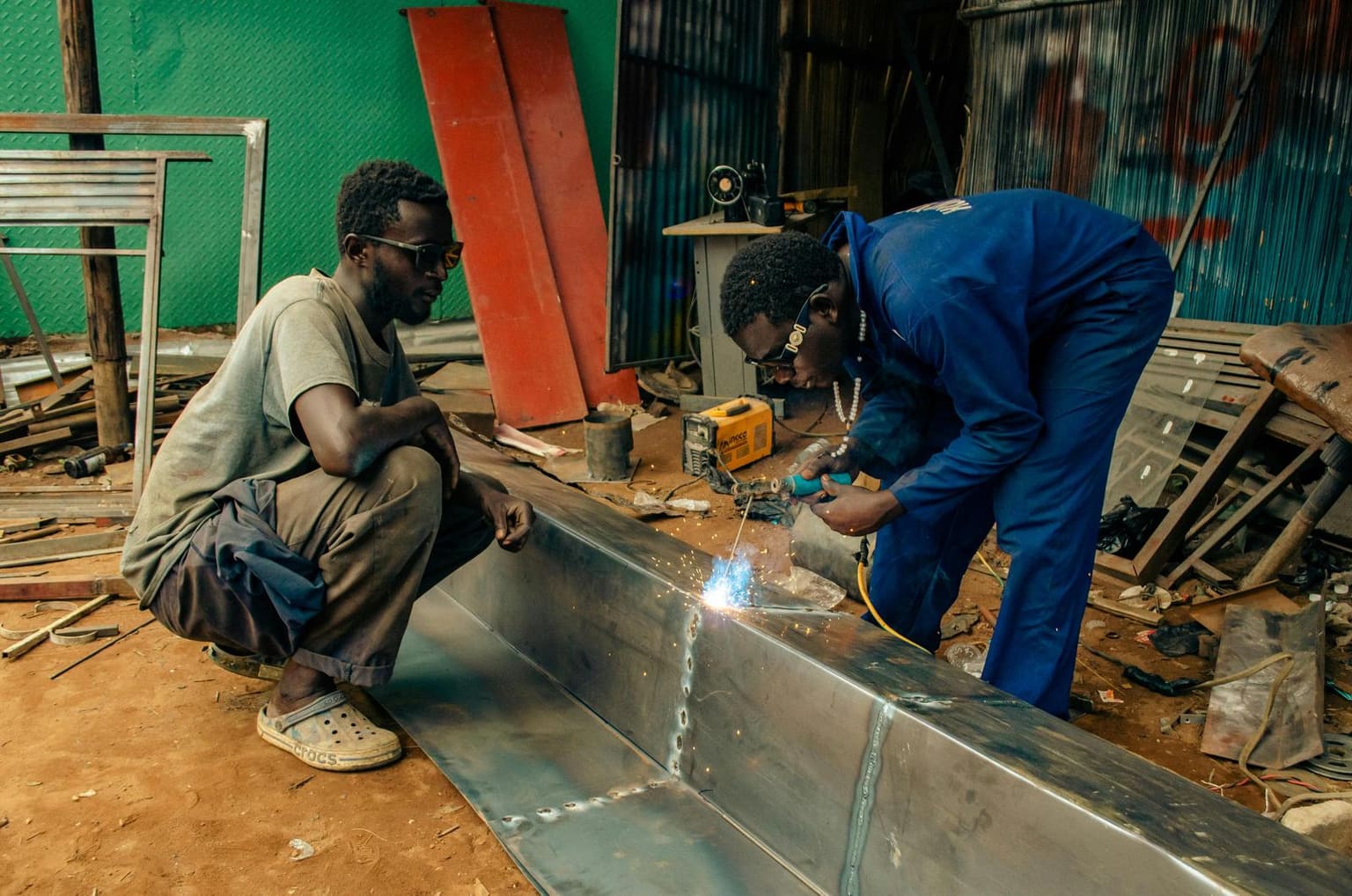
The best worktable for a Nairobi restaurant kitchen is locally fabricated in 1.2 mm Grade 201 | 304 (1.5 mm for heavy butchery), with fully welded joints ground smooth, a 100 mm backsplash upstand, and an undershelf. Standard size: 1,800 × 700 mm at 900 mm height with adjustable legs.
What to avoid: imported tables with unknown steel grade, pop-riveted (not welded) construction, and hollow unsupported legs. These fail early under commercial use and harbour bacteria at the rivet points.
Price range: KSh 28,000–45,000 for a locally fabricated 1,800 × 700 mm table. Significantly cheaper imported alternatives are almost certainly in a lower steel grade.
Best Commercial Kitchen Sinks for Restaurants in Kenya
For the prep area: a double-bowl Grade 201 | 304 sink, fully welded, with a pressed bowl minimum 450 mm deep. Pressed bowls (formed from a single sheet) are stronger than welded-corner bowls. The sink body should be mounted on adjustable legs, not bolted directly to the wall.
For the wash-up area: a triple-bowl Grade 201 | 304 sink for the three-stage wash process (wash, rinse, sanitise). Size the bowls to your largest item — a 500 × 500 × 400 mm bowl minimum for a restaurant kitchen.
For hand-washing: a wall-mounted Grade 201 | 304 hand basin, dedicated for hand-washing only. Do not share this sink with food preparation — HACCP requires a separate hand-washing point.
Price range: double-bowl prep sink KSh 20,000–35,000; triple-bowl wash-up sink KSh 35,000–55,000; wall-mounted hand basin KSh 8,000–14,000.
Best Extraction Canopies for Restaurant Kitchens in Kenya
The best extraction canopy for a restaurant kitchen is locally fabricated in Grade 201 | 304 with baffle-type grease filters (more efficient than mesh), adequate depth to provide 300 mm overhang beyond all cooking equipment, and a lip or gutter to collect and drain grease rather than letting it pool in the canopy.
Size it correctly: more restaurants in Kenya have undersized extraction than any other single equipment problem. An undersized canopy fails KEBS inspection and creates dangerous kitchen conditions. See our extraction sizing guide for the calculation.
Price range: a correctly sized wall-mounted canopy for a restaurant hot kitchen: KSh 60,000–140,000 depending on length. Island canopies cost more.
Best Grease Traps for Restaurants in Kenya
For restaurants up to 100 covers per day, an undersink inline grease trap in Grade 201 | 304 stainless steel, 50–100 litre capacity, is the correct specification. Avoid imported plastic grease traps — they degrade under hot kitchen wastewater and do not last in commercial use.
For restaurants exceeding 100 covers per day, an underground concrete or GRP grease interceptor of 500 litres or more is required by NEMA. This must be installed before flooring is laid — retrofitting is expensive.
Price range: undersink Grade 201 | 304 grease trap KSh 8,000–18,000; underground interceptor supply and install KSh 35,000–120,000 depending on size.