An undersized extraction hood is one of the most common — and most expensive — commercial kitchen mistakes in Kenya. A canopy that is too small for the cooking equipment below it allows heat, grease, smoke, and steam to escape into the kitchen, creating dangerous working conditions, triggering fire suppression systems prematurely, and failing KEBS and county health inspections. Getting the sizing right from the start costs nothing extra. Getting it wrong costs a full replacement.
The 300 mm Overhang Rule
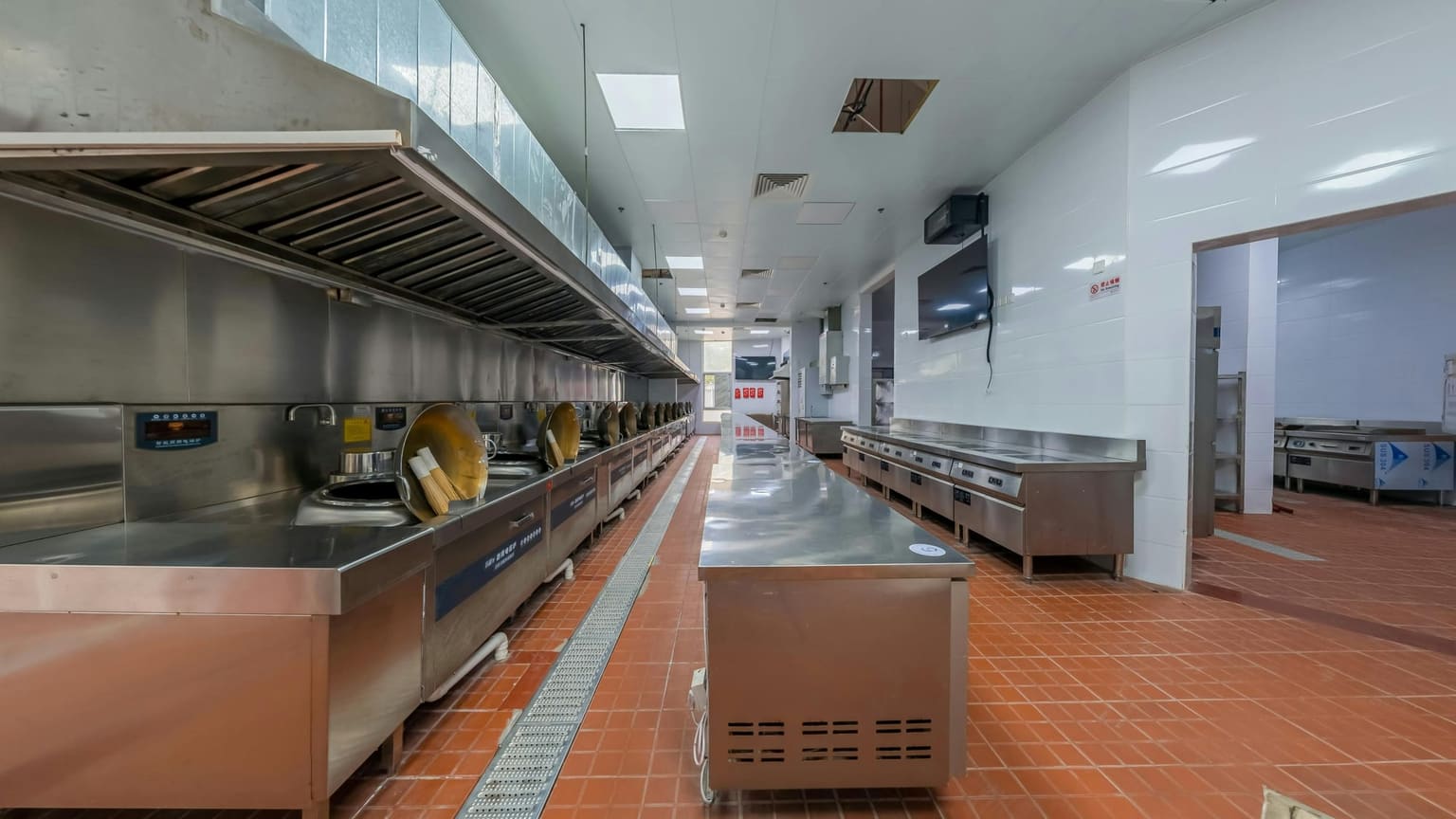
The fundamental rule for extraction hood sizing is simple: the hood must extend at least 300 mm beyond the outer edge of the cooking equipment on every exposed side. For a wall-mounted cooking suite that is 2,400 mm wide, the canopy should be a minimum of 3,000 mm wide (2,400 + 300 mm each side).
This overhang exists to capture the thermal plume — the column of hot air, steam, and grease-laden vapour that rises from the cooking surface and spreads outward as it rises. Without adequate overhang, that plume escapes the capture zone and spills into the kitchen.
For island cooking stations (cooking equipment surrounded by circulation space on all sides), the overhang requirement applies on all four sides, making the canopy significantly larger than the equipment footprint.
Calculating Airflow Requirements
Hood size alone is not enough — the extraction system must also move sufficient air volume (measured in m³/hr) to fully capture and remove the thermal plume from your specific cooking equipment.
As a general guide for Kenya's commercial kitchen conditions: light cooking equipment (prep ovens, bain maries, light fryers) requires approximately 300–450 m³/hr per linear metre of canopy. Heavy cooking equipment (open-burner ranges, chargrills, deep fryers, solid top ranges) requires 450–650 m³/hr per linear metre or more.
These are starting figures. A proper system design accounts for kitchen geometry (ceiling height, cross-ventilation), makeup air provision, and the specific heat output of your equipment. Beyond Commercial Kitchen sizes all extraction systems from an equipment schedule — contact us with your equipment list and kitchen dimensions for a precise specification.
Wall-Type vs Island Canopy
Wall-type canopies are mounted directly to the wall above a cooking suite that runs along a wall. The wall acts as one boundary of the capture zone, reducing the required canopy depth compared to an island hood. Standard wall-canopy depth is typically equal to the depth of the cooking equipment plus 200 mm at the front.
Island canopies hang from the ceiling above a freestanding cooking island. Because there is no wall to act as a backstop, island canopies must be deeper, wider, and higher-powered than equivalent wall canopies for the same equipment. Suspension height (the distance from the cooking surface to the bottom of the canopy) should not exceed 750 mm — higher than this significantly reduces capture efficiency.
KEBS and Compliance Requirements in Kenya
Kenya Bureau of Standards (KEBS) and Nairobi County food business licensing require commercial kitchens to have adequate extraction and ventilation. While Kenya does not yet have a single published airflow standard equivalent to CIBSE or ASHRAE, inspectors assess extraction systems based on practical performance: is the kitchen free from excessive heat and smoke buildup during cooking service?
In practice, a correctly sized and installed extraction system — one that meets the overhang and airflow guidelines above — will satisfy inspection requirements. Systems that are clearly undersized or non-functional are the primary cause of extraction-related licence delays.
Fire safety codes also require grease filters in the extraction path (removable stainless mesh or baffle type) to prevent grease accumulation in the ductwork — a significant fire risk. All Beyond Commercial Kitchen extraction canopies include removable grease filters as standard.
Make-Up Air: The Overlooked Requirement
A correctly sized extraction system creates negative pressure in the kitchen — it exhausts more air than is naturally entering. Without a make-up air provision (a fresh air supply that replaces the exhausted air), the kitchen depressurises, extraction efficiency drops sharply, and doors become difficult to open.
For kitchens exhausting more than approximately 1,500 m³/hr, a dedicated make-up air supply is essential. This is typically an air handling unit ducted to introduce fresh, filtered air at low velocity above the cooking zone. It is a mechanical services item your HVAC contractor specifies — but it should be planned during kitchen design, not retrofitted after the extraction is installed.